
US-based Qualcomm, the dominant supplier of the chips that drive code division multiple access mobile phones, and Reliance Communications have agreed to expand the use of the technology in India.
Betting big on India, the United States-based telecom technology major Qualcomm Inc on Friday said it would open a research and development centre in the country this year to write software for code division multiple access-based technology.

Qualcomm has been playing a key role driving India's wireless revolution

Bharti Airtel Ltd, India's top telecommunications carrier, said on Friday it had bought out Qualcomm Inc's stake from a fourth-generation (4G) broadband joint venture in the country, taking full ownership of the business more than a year earlier than planned.
In a move that could bring down prices of CDMA handsets further, Qualcomm Inc has licensed Himachal Futuristic Communications Ltd to manufacture 3G CDMA2000 mobile handsets, fixed-wireless phones and line modem cards.

It can offer internet access and the user would also be able to make phone calls.

Bharti Airtel on Thursday said it has acquired 49 per cent stake in Qualcomm's broadband wireless access (BWA) business in India for USD 165 million (about Rs 922 crore).
Shares of CDMA technology pioneer Qualcomm have come under tremendous pressure over the past one month, losing a market cap of $11.7 billion on the back of Reliance Communication, one of its major customers, mulling the option of switching to GSM.

The move is being considered after growing clamour from competing 4G operators for a level playing field in relation to Qualcomm.

Qualcomm has possible intentions of hoarding spectrum should it win the spectrum in the forthcoming auction, Wimax Forum chairman C S Rao said.

Qualcomm, the $11.14-billion digital wireless communications products and services provider, will introduce its low-cost video game console -- Zeebo -- in India by 2010. The company will also launch in India its FLO TV, which is size of an iPhone and currently available in the US.

The United States-based mobile chip maker Qualcomm today sold 26 per cent stake in broadband unit in India to Tulip Telecom and Global Holdings for $57.72 million (about Rs 268 crore).

The Delhi High Court on Tuesday permitted Chinese mobile phone maker Xiaomi to sell and import Qualcomm chipset based handsets till January 8, as a temporary measure.

The JV between the two has won BWA spectrum in Delhi, Mumbai, Haryana and Kerala.

'By the end of 2022, we expect the installed base of 5G smartphones in India to reach 80-85 million.'

Qualcomm has plans to launch its new processor in single, dual and quad-core versions with integrated multi-mode technology to support 4G technology.

Ola Electric is moving the delivery for the first batch of its electric scooters to between December 15 to the end of the month, a two- to four-week delay from its earlier schedule, due to a shortage of chipsets and electronic parts. The first batch of deliveries were scheduled for November 30 but the company decided to delay them after a meeting between its factory team and the global supply chain on Saturday. It became clear that the late delivery of chips and electronic parts was only 'getting worse', sources told Business Standard. Ola has apologised to customers for the delay and said it is "ramping up production as fast as we can so that you can get your Ola S1 at the earliest". It has stopped taking any new bookings until the chip shortage has eased, say sources.

CDMA mobile pioneer Qualcomm is banking on BREW (Binary Runtime Environment for Wireless), its open source application development platform for wireless devices, to deliver the next killer-app for the fast-growing data services market.
Qualcomm India, Pvt. Ltd's fourth Works@Work art exhibit which will open on March 13, 2008 at the Company's offices in the Bandra-Kurla Complex, Mumbai.

The merits and demerits of the telcos' 5G strategy however is clearly dependent on the financial muscle of players, reports Surajeet Das Gupta.

The voice revenue per minute in India is among the lowest in the world at around 50 paise, says Kanwalinder Singh, President,Qualcomm India.

This year will be the one when GenAI becomes a part of the daily lives of people around the world.

Micron plans an assembly testing, marking and packaging project of $1 billion, and talks are on to set up a memory chip plant for captive requirements.

Will open radio access network technology (O-RAN) disrupt the way 5G networks roll out in the country? After all, it promises to offer a substantially lower capital cost, enables the choice of an array of vendors, and provides more network flexibility - all very important for telcos who expect to invest over Rs 60,000 crore to roll out a pan-India 5G network and that's without spectrum costs. But more importantly, it counters the stranglehold of global telecom gear makers such as Ericsson, Nokia, and Samsung over telcos to whom they sell propriety technology and bundled hardware and software.

Isha's stab at the bottom of the laptop pyramid shows she is a true Ambani.

The government is close to approving a proposal by Micron Technology to set up an assembly, testing, marking and packaging (ATMP) facility in the country involving an investment of about $1 billion. The world's fifth largest semiconductor company, based in Idaho, USA, will use the facility to process some of its own wafers, manufactured across the globe.
Reliance Industries chairman Mukesh Ambani on Monday announced a Rs 2 lakh crore investment in deploying fifth-generation or 5G telephony with rollout in metro cities by Diwali. Jio, the nation's largest telecom operator, has deployed standalone 5G stack rather than upgrading the existing 4G network, to offer ultra-high speed internet, he said at Reliance Industries' 45th AGM.

The chipset accounts for over 25%-30% of the cost of an average smart phone. Hence, a reduction in its price, device makers say, will make a huge difference to the cost of a phone.

Prime Minister Narendra Modi began his engagements in the US on Thursday by meeting with leading American CEOs from five different key sectors and highlighted the economic opportunities in India.
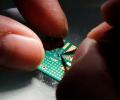
Foundries in Taiwan account for more than 75 per cent of the chips that mobile devices made in India need, according to estimates by the Indian Cellular and Electronics Association (ICEA), which represents global and domestic manufacturers. The number is slightly lower, 60 per cent, if one considers all chips -- those of consumer electronics, PCs, laptops, autos, etc. This ties in with the fact that foundries in Taiwan, led by TSMC, account for over 70 per cent of the world's microchip supply, according to estimates by Gartner.

On Thursday, the prime minister is scheduled to hold one-on-one meetings with top five American CEOs. Two of them are Indian Americans -- Shantanu Narayen from Adobe and Vivek Lall from General Atomics. The three others are Cristiano E Amon from Qualcomm, Mark Widmar from First Solar, and Stephen A Schwarzman from Blackstone.

With a million-odd electric vehicles (EVs) - two-wheelers, e-rickshaws, buses and passenger cars - expected to hit the road this calendar year, the shift from gasoline-powered vehicles has become irreversible. Now the question is whether the supply chain is ready for this shift. Key components - the high-powered lithium-ion battery and the cells which go with it, the electric motor, and the electronics powered by chips - account for nearly 60 per cent of the cost of an EV.
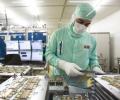
Mumbai-based Indian Semiconductor Manufacturing Company (ISMC) and Singapore-headquartered IGSS Ventures have one strategy in common: They have told the government in their application for semiconductor fabrication plants that they will export the bulk of the chips they make in India in the initial five or 10 years. The third applicant, Vedanta-Foxconn, which is also building a fab plant, has said it will concentrate on the needs of consumer electronics and mobile device markets, and earmark 80 per cent of output for domestic consumption, but has not specified its customers. Finding a viable domestic market could well be the biggest challenge for India's renewed tryst with semiconductors. Fab plants do not sell directly to end users but to intermediary chip design companies - such as Qualcomm or MediaTek.

Chinese phone maker Xiaomi's India unit has been slapped with a Rs 653 crore notice for alleged evasion of import duty, as per an official statement. A show-cause notice has been slapped on Xiaomi India following recovery of documents during searches on its premises that indicated remittance of royalty and licence fee to US and Chinese firms under contractual obligations, the union finance ministry said on Wednesday. Replying to an email query, a Xiaomi spokesperson said, "At Xiaomi India, we give utmost importance to ensuring we comply with all Indian laws.

The average salary received by students during campus placements for 2021-2022 was Rs 21.48 lakh per annum. The highest salary offered was $250,000.

Smartphone shipment in India declined by 10 per cent to hit a three-year low of 43 million shipment in the July-September 2022 period, market research firm International Data Corporation said on Monday. The 5G smartphone share reached 36 per cent of total smartphones during the reported quarter with 16 million units at a slightly higher average selling price of $393, about Rs 32,000, apiece compared to $377, about Rs 30,600, in the previous quarter. "India smartphone market declined 10 per cent year-over-year (YoY) shipping 43 million units in July-September 2022.
 © 2026 Rediff.com - Advertise with us - Disclaimer - Privacy Policy - Sitemap - Feedback - About us - Terms of use - Grievances